Benefits of Using Inconel 718 Bars in High-Stress Mechanical Applications
Posted by Ashok Munot
Filed in Business 36 views
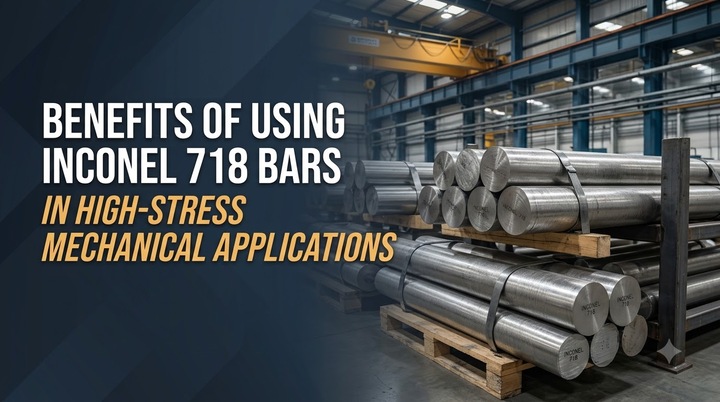
Demanding engineering applications require materials capable of retaining strength under extreme temperatures and repeated mechanical loading. Engineers face constant challenges with components degrading prematurely under severe operational conditions. Standard alloys often fail when pushed beyond their thermal or mechanical limits. The selection of base material dictates the entire lifecycle of a high-stress component. Industries rely heavily on advanced metallurgical solutions for these severe environments. For parts that are subjected to cyclic stress or high temperatures, a high structural stability is required. The properties of these challenging specifications make Inconel 718 Round Bars widely used in numerous industries. Inconel 718 round bars are specified by engineers for particular characteristics they require for long service life. It offers high strength, yet good mechanical properties, and remains weldable and corrosion resistant.
Why High-Stress Mechanical Components Require More Than Conventional Stainless Steel
Standard engineering materials struggle with cyclic loading and creep in extreme environments. Vibration and fatigue quickly deteriorate standard alloys. People frequently inquire whether Inconel 718 is a type of stainless steel during the material selection phase. It is not stainless steel; rather, it is a nickel‑based superalloy specifically engineered for extreme service conditions. Conventional stainless grades lack the specific precipitation hardening phases required to endure severe thermal cycling. They lose structural integrity at elevated temperatures, while this superalloy maintains its mechanical properties continuously.
How Inconel 718 Bars Maintain Strength Under Extreme Mechanical Loads
These alloys handle extreme mechanical loading through their unique metallurgical structure. They exhibit exceptional tensile strength and fracture toughness under severe operational stress. The material resists crack propagation effectively. Components maintain load-bearing capability during continuous vibration and cyclic loading.
Fatigue resistance remains consistently high over extended service periods. Creep resistance allows the material to resist deformation under long-term mechanical stress at elevated temperatures. Structural stability at elevated temperatures maintains predictable operation in demanding environments. Excellent oxidation resistance protects the surface integrity of inconel 718 bars during prolonged thermal exposure.
The Role of Heat Treatment in Achieving the Full Performance of Inconel 718 Bars
Proper thermal processing dictates the final mechanical characteristics of these components. A specific inconel 718 heat treatment cycle develops the required internal structure. The process begins with solution treatment to dissolve alloying elements uniformly.
Age hardening follows this step to promote precipitation strengthening throughout the metal matrix. This controlled precipitation creates microscopic barriers that restrict dislocation movement within the crystalline structure. The resulting improved mechanical performance allows the material to handle extreme operational loads. Long-term dimensional stability is achieved directly through these careful thermal processing phases.
Mechanical Engineering Applications Where Inconel 718 Bars Outperform Conventional Alloys
Advanced manufacturing sectors consistently select high-strength nickel alloys for their most critical components. These specific industries demand exceptional reliability under severe mechanical stress conditions.
Turbine shafts
Rotational forces place massive stress on power generation equipment. These central rotating components require absolute dimensional stability at high speeds. The material prevents catastrophic failure during continuous high torque operation.
Fasteners
High-strength bolts secure critical assemblies in extreme environments. The alloy prevents thread shearing and tension loss under severe vibration. These joining components maintain clamping force despite massive temperature fluctuations.
Aerospace components
Aircraft engines demand materials with exceptional thrust-to-weight ratios. Landing gear structures must survive massive impact forces during touchdown. These superalloys deliver the exact mechanical reliability required for flight.
Gas turbine equipment
Combustion chambers operate at extreme thermal limits constantly. The hot sections require materials that resist oxidation and structural degradation. These high-temperature alloy bars provide reliable service in these zones.
Oil and gas tools
Downhole drilling equipment faces aggressive subterranean pressure and corrosive fluids. The material prevents tool failure miles below the surface. These robust, solid parts survive severe torsional stress during drilling operations.
High-pressure valves
Flow control systems handle extreme fluid velocity and physical pressure. The valve stems and bodies must resist galling and deformation. This specific alloy stops dangerous leaks in demanding pipeline infrastructure.
Nuclear engineering components
Reactor environments subject materials to intense radiation and heat. Control rod mechanisms demand absolute precision and reliability. Stress-resistant materials prevent structural degradation in these highly sensitive power generation facilities.
Heavy-duty mechanical equipment
Industrial machinery requires internal components that survive continuous heavy loading. Drive shafts and gears face constant mechanical friction and stress. These tough alloys prevent premature wear in massive industrial systems.
Key Selection Factors When Choosing Inconel 718 Round Bars for Critical Components
Engineers must evaluate several specific parameters before specifying these mechanical engineering materials. Proper material selection directly impacts the functional lifecycle of the final machined assembly.
-
Engineers must determine the exact maximum service temperature the component will experience during normal and peak operational conditions.
-
Calculations of mechanical loading dictate the exact diameter and length required to prevent structural yielding under physical stress.
-
Evaluating specific fatigue requirements confirms the component will survive the expected number of operational cycles without cracking.
-
Assessing potential corrosion exposure helps confirm the material will resist degradation from environmental chemicals or industrial fluids.
-
Procurement teams must verify absolute ASTM B637 compliance to confirm the raw material meets strict international aerospace standards.
-
Specifying the correct heat treatment condition guarantees the delivered material possesses the required mechanical strength for machining.
-
Reviewing the material certification confirms the exact chemical composition and physical properties match the engineering design specifications.
-
A robust supplier quality assurance program prevents substandard materials from entering the critical manufacturing supply chain.
Conclusion
Selecting the correct metallurgical grade prevents catastrophic equipment failure in severe environments. Reduced maintenance and longer component life justify the initial material investment completely.
Engineers achieve high structural integrity and dependable performance with these advanced superalloys. They remain the superior choice for demanding mechanical applications instead of relying on standard lower-grade engineering materials.