AR 600 Plates vs AR 500 Plates: Which Grade Delivers Better Wear Life?
Posted by Ashok Munot
Filed in Business 34 views
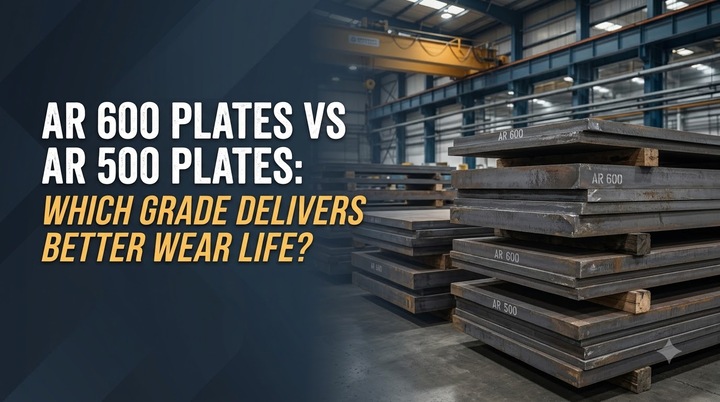
Selecting a Wear Resistant Steel Plate requires balancing wear resistance against impact performance, fabrication limits, and lifecycle cost. Both AR 500 Plate and AR 600 Plates are quenched and tempered grades built for severe environments. Engineers often source AR 600 Plates for extreme conditions. Higher hardness improves sliding abrasion resistance significantly. It does not automatically make it a better choice for every application. Increasing the hardness level reduces ductility and makes fabrication more difficult.
Understanding AR 500 and AR 600 Wear Plates
Abrasion-resistant steel plate materials undergo a specific quenching and tempering process at the mill. This heat-treated construction creates a very tough martensitic microstructure. High Hardness Steel Plate classifications indicate the nominal hardness level of the steel. Sectors like mining, cement, and construction rely heavily on these specific materials.
Picking the correct hardness for specific service conditions dictates how long the equipment actually lasts. Over-specifying hardness can easily lead to premature cracking under heavy impacts. Plant engineers must evaluate the exact operating environment rather than just ordering the hardest available AR 600 Wear Plate for every component.
AR600 vs AR500: Key Property Comparison
Comparing AR600 vs AR500 requires looking at hardness limits alongside other mechanical properties. The table below outlines the primary differences in performance and fabrication behavior between these two specific grades.
|
Property |
AR 600 Plates |
AR 500 Plate |
|
Typical Hardness (HBW) |
Higher |
Lower |
|
Abrasion Resistance |
Excellent |
Very Good |
|
Impact Toughness |
Moderate |
Better |
|
Fabrication |
More Difficult |
Easier |
|
Weldability |
Requires Greater Control |
Easier |
|
Typical Service Life |
Longer in high-abrasion conditions |
Better balance for mixed wear |
AR 600 Plates typically have a hardness of about 570 to 640 HBW. An AR 500 Plate commonly falls around 470 to 540 HBW. This difference results in improved abrasion resistance for AR 600. The trade-off is reduced ductility during field installation.
Which Grade Delivers Better Wear Life?
Severe sliding abrasion destroys standard steel rapidly. High-friction environments with continuous material flow demand hard surfaces to prevent material loss. AR 600 Plates generally deliver much longer wear life in these severe sliding abrasion scenarios. An AR 500 Plate often performs better where abrasion and impact occur together. Dropping large rocks onto a surface will easily crack a highly brittle plate. The operating conditions dictate the final choice between managing friction or surviving impact.
Typical Applications for Each Grade
Industrial facilities use these steel grades for specific equipment components. The application dictates the final choice based on the exact type of material being processed.
Mining Operations
A Mining Wear Plate experiences constant sliding friction from extracted ores. The higher hardness of grade 600 resists this extreme abrasion effectively. This extends the working life of processing chutes.
Quarrying Sites
Crushing extracted rocks generates severe wear on handling equipment. Plant managers install these extremely hard plates to meet high wear resistance requirements. This keeps the stone sorting machinery operational longer.
Cement Plants
Moving clinker creates continuous material abrasion inside the plant network. Facilities rely on extremely hard steel to line their hoppers. The material handles this severe, constant grinding action very well.
Dump Truck Liners
Heavy transport vehicles take severe punishment from falling materials. Choosing between grades depends entirely on the exact impact level. Larger rocks require better toughness to prevent structural failure during loading.
Construction Equipment
Earthmoving machines need plates that can withstand moderate impacts and bending. A Heavy Equipment Wear Plate in grade 500 provides better toughness. It allows easier welding during heavy field repairs.
Material Handling
Conveyor systems face different challenges based on the transported goods. Selection depends directly on specific wear conditions. Proper engineering evaluation determines the exact grade needed for each separate transfer point.
Factors to Consider Before Selecting AR Wear Plates
Material selection must consider the complete operating environment rather than hardness alone. Evaluating several key technical parameters ensures the correct steel specification for the job.
-
Engineers must accurately identify the primary type of wear affecting the machinery before ordering replacement parts.
-
The impact severity of heavy falling materials directly dictates the required ductility limit of the chosen steel.
-
Evaluating the required plate thickness helps determine the overall equipment weight and structural load on the machine.
-
Complex fabrication requirements often restrict the use of very high-hardness steels due to bending limitations.
-
Maintenance teams must plan specific preheating and welding procedures carefully to avoid delayed cracking issues in service.
-
The expected maintenance interval strongly influences how thick the installed replacement wear plate should actually be.
-
Calculating the total lifecycle cost of the installation proves much more valuable than checking the initial material price.
-
The structural equipment design must safely support the stiffness and rigidity of the specifically chosen steel grade.
Conclusion
AR 600 Plates are the preferred solution for applications dominated by severe sliding abrasion where maximum wear life is required. An AR 500 Plate remains an excellent choice for applications involving a combination of abrasion alongside impact loading and easier fabrication. Engineering requirements and total lifecycle performance dictate the final grade.