Duplex Steel UNS S31803 vs. Carbon Steel Sheets: A Complete Comparison for Long-Term Value
Posted by Kailash Mittal
Filed in Business 47 views
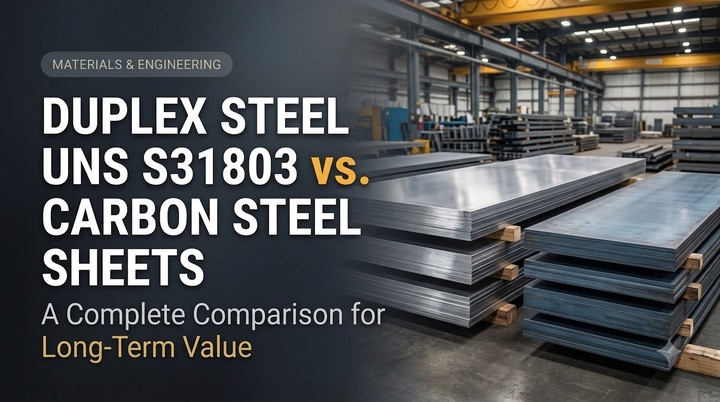
Sheet material selection requires looking at the total lifecycle value rather than just the initial purchase price. Industrial projects that involve severe corrosion, heavy structural loading, and a need for long service life often require comparing different metal grades. Engineers frequently evaluate duplex steel UNS S31803 sheets against standard carbon steel sheets. Both materials function well in specific environments. The correct choice depends on understanding how they behave under operational stress over decades.
Why Initial Material Cost Doesn't Tell the Whole Story
The upfront cost of a metal sheet is only a fraction of the actual expense. Facilities must calculate the Total Cost of Ownership before finalizing a material choice. Evaluating duplex steel vs carbon steel shows a massive difference in ongoing operational expenses. Carbon steel is very cheap to purchase, but often demands high maintenance requirements. Plant operators have to pay for continuous corrosion protection expenses year after year. Frequent repainting or galvanizing adds up quickly in the budget. In harsh industrial environments, the replacement frequency of basic steel increases. This leads to heavy downtime costs when equipment shuts down for structural repairs. The lifecycle cost of a cheaper metal often exceeds the initial price of a premium grade.
Duplex Steel UNS S31803 vs Carbon Steel Sheets: Property-by-Property Comparison
Carbon steel has a lower initial purchase cost. However, an uns s31803 sheet provides better long-term value in corrosive environments. The higher strength and reduced maintenance make it a practical choice for demanding operations.
|
Comparison Parameter |
Duplex Steel UNS S31803 Sheets |
Carbon Steel Sheets |
|
Material composition |
Contains high levels of chromium, molybdenum, and nitrogen |
Primarily made of iron and carbon elements |
|
Corrosion resistance |
Exceptionally high against general pitting and crevice corrosion |
Very low without applying external protective barriers |
|
Yield strength |
Very high yield strength rating of approximately 450 MPa |
Lower yield strength rating of approximately 250 MPa |
|
Tensile strength |
High tensile capacity for handling heavy industrial loads |
Moderate tensile capacity suitable for basic structural support |
|
Weight-to-strength ratio |
High ratio allows engineers to use thinner plates |
Low ratio requires thicker plates for the same load |
|
Stress corrosion cracking resistance |
High resistance in environments containing chloride ions |
Low resistance and highly susceptible to cracking failures |
|
Protective coating requirement |
Rare requirement unless exposed to extremely severe conditions |
Mandatory requirement in almost all outdoor or wet environments |
|
Maintenance frequency |
Very low frequency resulting in minimal operational interruptions |
High frequency requiring regular inspections and surface recoating |
|
Service life |
Long expected duration often exceeding fifty continuous years |
Moderate duration highly dependent on strict maintenance schedules |
|
Initial cost |
Higher initial material procurement and fabrication expense |
Lower initial material procurement and basic fabrication expense |
|
Long-term operating cost |
Low operating cost due to zero maintenance needs |
High operating cost driven by constant repairs and downtime |
|
Suitable industries |
Chemical processing, marine engineering, and oil extraction |
Standard construction, dry indoor structures, and automotive parts |
Where Duplex Steel UNS S31803 Sheets Deliver Better Long-Term Value
Certain environments justify a higher upfront material budget. Marine and offshore facilities use duplex steel sheets because constant salt spray destroys unprotected metals rapidly. Chemical processing plants require materials that can handle aggressive acids without failing. Desalination systems run continuously under high pressure in chloride-rich water. Oil & gas installations face similar issues with sour gas exposure. Structural applications requiring high strength also benefit heavily here. The material allows engineers to use thinner plates. This reduces the total structure weight. The combination of high corrosion resistance and mechanical strength drops lifecycle costs significantly for the plant operator.
When Carbon Steel Sheets Remain the Better Choice
There are many situations where carbon steel remains economical and highly practical. Dry indoor environments do not pose a severe rust threat to the metal. Standard carbon steel works perfectly well for structural supports inside climate-controlled buildings. Temporary structures rarely need materials designed to last fifty years. Budget-sensitive projects often dictate the use of lower-cost metals initially. Low-corrosion operating conditions make premium alloys completely unnecessary. Facilities should not spend extra money if the specific environment does not demand it. The main goal is to match the exact material grade to the actual operational risk. A balanced approach prevents unnecessary engineering expenses.
Engineering Questions to Ask Before Selecting Sheet Material
Selecting the correct metal requires looking at the specific operational variables. Engineers need to verify exact project conditions before contacting a duplex steel sheet supplier for an ASTM A240 UNS S31803 sheet. Review the following parameters to ensure the chosen material meets the technical requirements of the facility.
-
Will the sheets be exposed to chlorides? Facilities near oceans or salt plants must evaluate this carefully.
-
Expected design life. A facility meant to operate for ten years has different needs than a fifty-year plant.
-
Maintenance accessibility. Areas that are difficult to reach for regular painting require materials that survive without coating.
-
Corrosion risk. Analyze the specific chemicals, moisture levels, and temperature fluctuations in the operating zone.
-
Structural loading. Determine the exact weight and pressure the metal plates must support during full capacity operations.
-
Budget vs lifecycle cost. Compare the initial purchasing limit against the acceptable maintenance spending over the next decade.
-
Applicable ASTM specification. Ensure the selected metal grade matches the legal and engineering standards required for the project.
Conclusion
The right material depends on the operating environment, maintenance strategy, and expected service life. Carbon steel suits low-corrosion applications. However, duplex steel UNS S31803 sheets provide superior long-term value where durability, corrosion resistance, and reduced maintenance are critical. Buyers must consult a reliable supplier for grade selection.